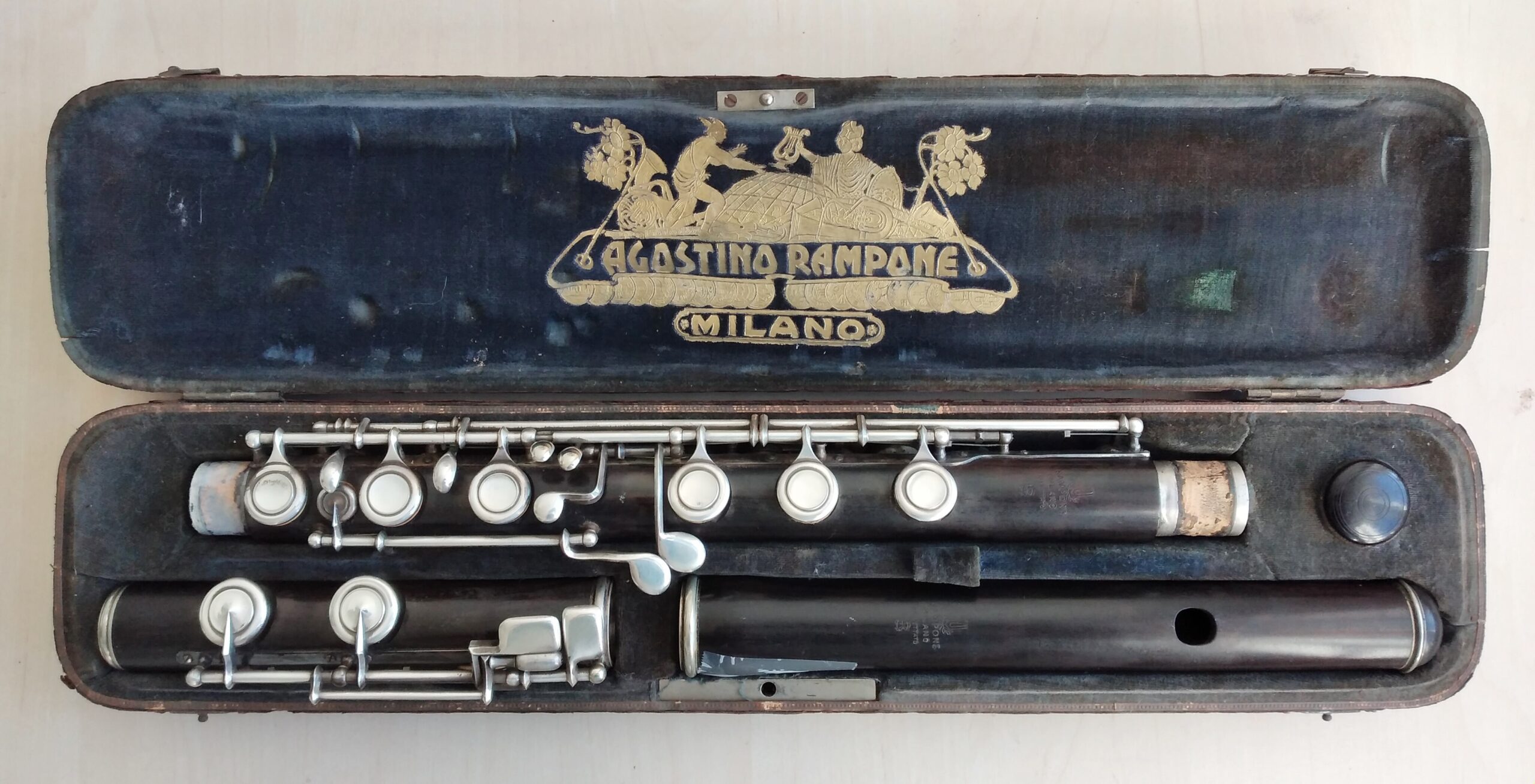
The battle between the Boehm system and the "old system" continued for a long time, arriving to our day. Rampone catalogs offered conical flutes (the "conical" or "cylindrical" refers to the shape of the inner tube) with "old system" fingerings throughout the 1970s. The reasons for the Boehm system's failure to triumph completely were the delicate sound of conical flutes and the reluctance to learn the new Boehm fingering. Experiments were made in every direction: some wanted the old fingering on metal cylindrical flutes, others wanted the Boehm fingering on wooden conical flutes, and others developed complex fingerings on conical flutes, like Schwedler. The flute I present today is a rare testament to these events: it is a cylindrical flute with an old-fashioned fingering but with the appearance of a Boehm flute. I have no idea who this flute might have been intended for—an old-fashioned flutist who wanted to present himself as modern? To fool a conductor who wanted modern flutes in his orchestra? Rampone then developed this instrument and included it in his 1921 catalog, calling it the "Finto Boehm (Fake Boehm)." One can only admire Rampone's determination to please everyone, to colonize every corner of the market. The flute is very beautiful and well-crafted, made of ebony with nickel-silver alloy keys.